April 15, 2015

Confessions of a Cutty Guide


During the season, sometimes I wonder what it would be like to work on another river, to be excited about row after row of neatly organized, tiny nymphs.  Sometimes I wonder what it would be like to test my skills against a species of fish that isn't so unapologetic about taking an over-sized, floating piece of foam.


But then I realize, I just gave up the best seat in the house.


Love the fish.  Love the fishery.


April 6, 2015

Mushroom and Bear Sausage Risotto


Ingredients:


1/2 lb black bear sausage
8-10 Asparagus stalks
1 cup arborio rice
2 cups stock (chicken, or game)
1/4 cup grated parmesan cheese
1/2 cup sliced mushrooms
1/4 white wine
2 tbs butter

Salt and pepper to taste


In a medium skillet, cook the bear sausage until brown and crispy, rendering out the fat and flavor to build your risotto on.   Remove cooked sausage and set aside.  Add 2 tbs of butter and add rice.   As the rice cooks, make sure each grain gets coated with the rendered bear fat and butter.   Slightly brown the rice, careful not to let it fry in the pan.  Deglaze with white wine.  Then start stirring and slowly adding stock, allowing the rice to absorb the liquid before adding more stock.

In a separate pan, saute mushrooms and asparagus.

Continue to stir the risotto until it has absorbed all the stock.  It will slowly release its starch creating a creamy consistency.  Return bear sausage back to the risotto, along with the mushrooms and asparagus. Finish with parmesan cheese, and salt and pepper.

February 15, 2015

Marsh Hens and Collards


Grilled Marsh Hens w/ Wild Rice and Homegrown Collards


Legs on a game bird suck.  Tough, full of tendons, too much work and not enough meat.
I'm a leg man, so I disagree.  Well, to be more honest, I'm a equal opportunist when it comes birds; legs, breasts, *gizzards, I'll take it all -sometimes even the feet.  

*If you haven't had the privilege of ordering fried gizzards from a small town, dive bar kitchen, after a a long day looking for birds, and a few pitchers of cheap beer, I would sincerely recommend it.


But the legs on a marsh hen are where it's at, which is not surprising considering they make up almost 60% of the bird's body.


Grilled Marsh Hens

A dozen marsh hens (breasts and legs separated)
     -marinate in red wine, just enough to cover the birds
         *it seemed that the longer the birds rested in the refrigerator, the more pronounced the marshy, salty flavor became.  Which is good.  It's not chicken.

Heat grill.

-A grill works in two ways:  If you can't get it above 350 degrees, it's called an outdoor oven.  If you want it to actually grill, and get a good sear, you'll need a higher temperature.

The hardest part about grilling is finding the hottest part of the grill.  Place your bird parts on the hottest part to get your grill marks.   If the grill is hot enough, it shouldn't take long.  Then flip the legs or breasts over, and move to a less hot section of the grill, close the lid, and use the grill as an oven to cook the birds the rest of the way through.

Grill in batches
6-8 minutes per bird part.


A Week Well Spent


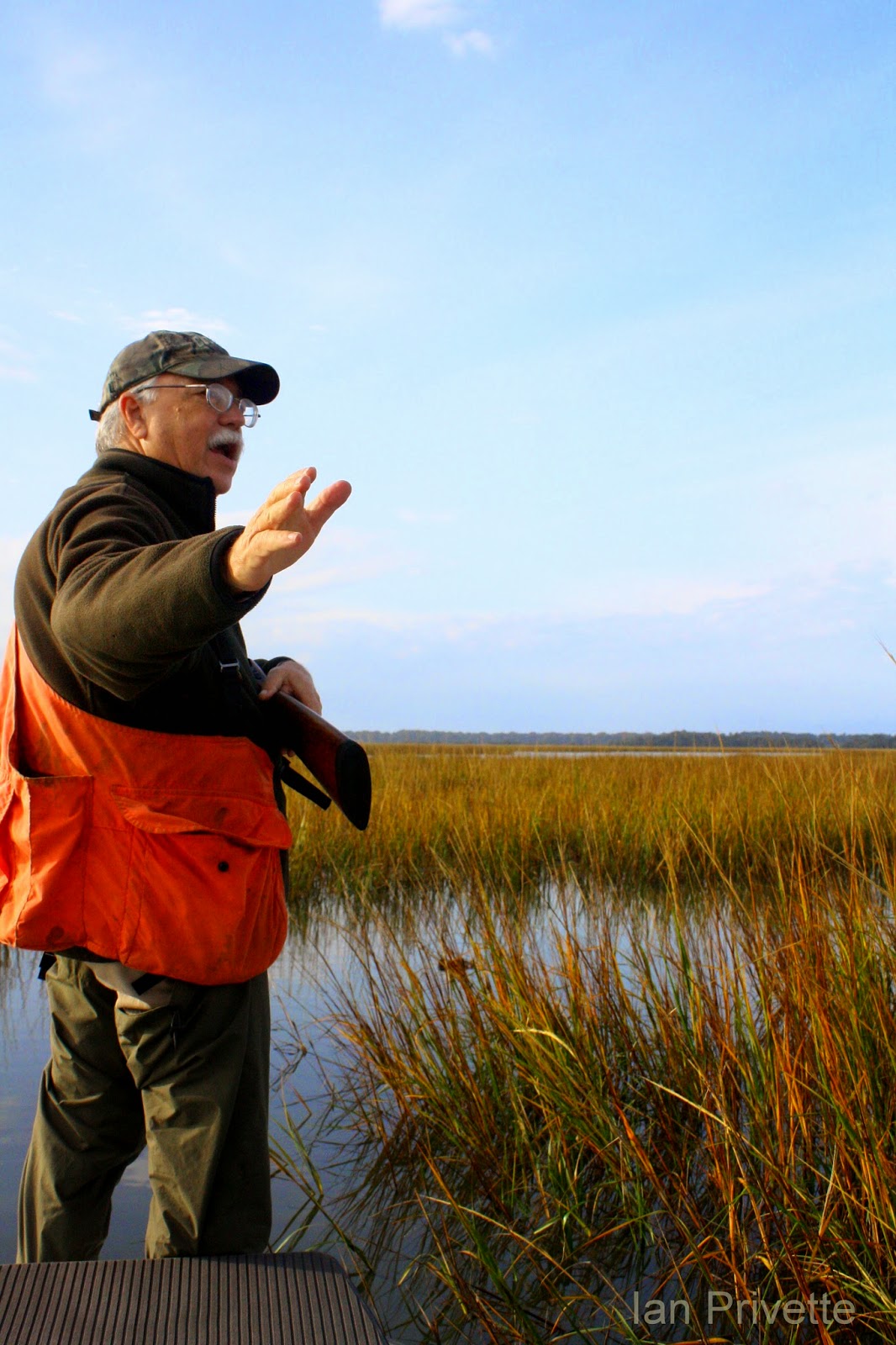
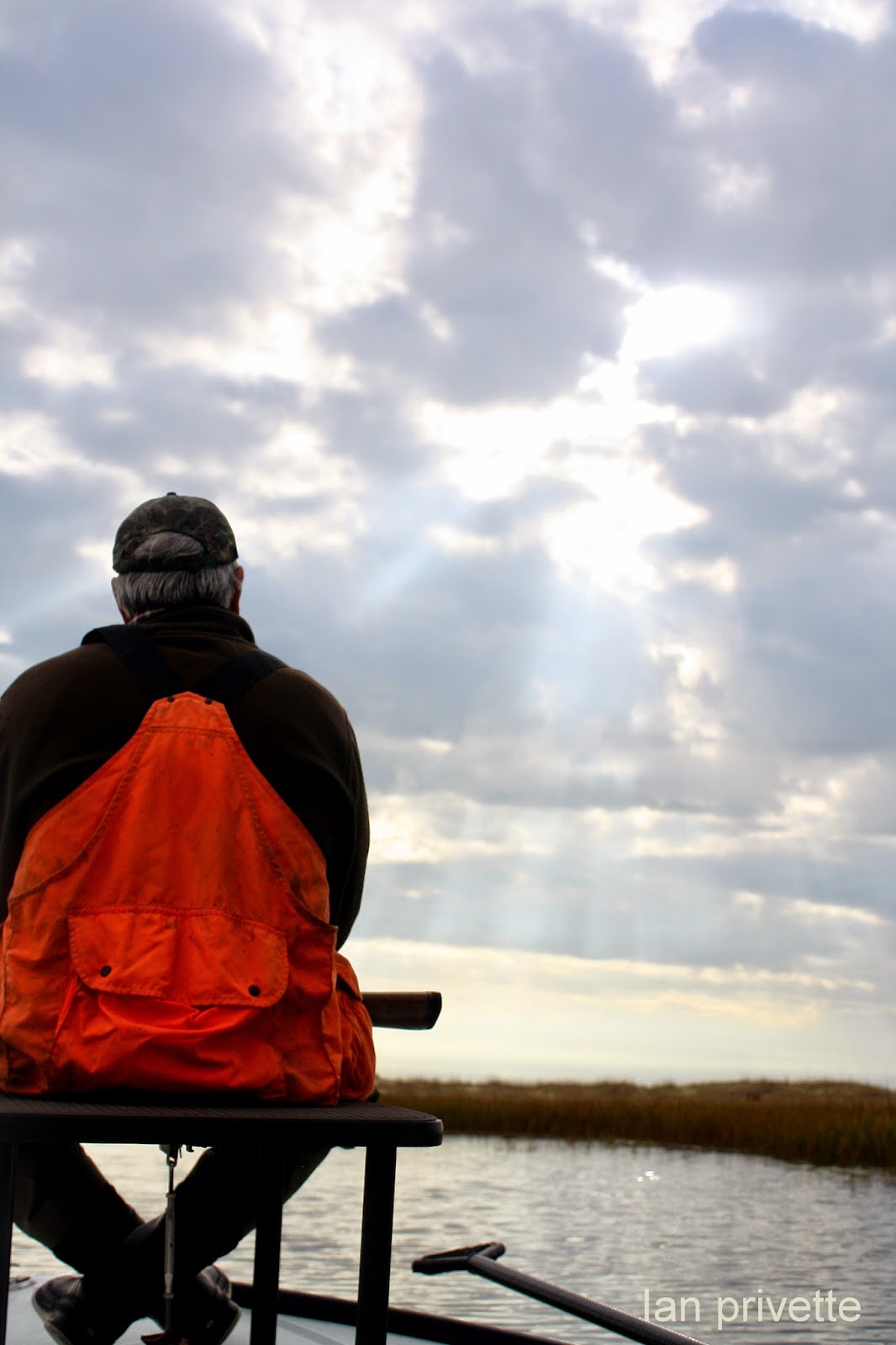
A rail hunt, an oyster roast, chasing bobwhites with old friends at Wintergreen and G&T 's on the house (the folks' house to be exact)  - Not a bad checklist for a week in SE North Carolina.  There also happened to be a holiday in there somewhere, involving turkeys and out of control grandmothers.  Here's a few shots from a week well spent.

The old man shooting rails, but still talking turkey


Morning sky over the marsh

Don't Shoot Too Fast


Special thanks to Capt. Seth Vernon of DoubleHaulGuideService and fellow guide Capt. Judson Brock for their marsh hen expertise.


"I'll take a lot. And put it in a bucket"


The old stomping grounds
Wintergreen Hunting Preserve


Orvis No. 8's


January 20, 2015

Sleepytime Explosion Stone

Sleepytime Explosion stone?? Who named this fly... Borat?


My first day at Spotted Bear Ranch as a newbie guide was a memorable one, to say the least.  The head guide at the time walked in with a man wearing what looked like a big, palm-leaf sombrero.
"So you're the new guy, huh? " the head guide asked,  "Let me see your fly box."

I was a little intimidated.  I had never seen a palm-leaf hat that big before.

I had spent the whole winter tying flies in preparation for my first year as a guide.  I was proud of my size 18 zebra midges and hacked together pheasant tails.

"Yeah, that stuff isn't gonna work here."  the head guide quickly remarked as he assessed the contents of my fly boxes.  He handed me MFC's catalog.  "Find 10 patterns in here and put together an order for tomorrow."

The next day I shadowed him on a float down the "lower" stretch of the river and watched fish after fish come up on a Davies' Purple Explosion Stone.

Stoneflies.

Big Stoneflies, a world away from my micro nymphs.

Lesson Learned.


Spotted Bear's big goldens are typically nocturnal. (most likely shortwing stoneflies).  But unlike hungover college students, trout will definitely remember their midnight snack the next morning, without the help of a crumpled up receipt.


Here's a step by step for this davies explosion stone inspired stonefly pattern.  Honorable mentions for names include:  Nocturnal Nancy.  Golden Ticket.  The Midnight Munchie.


  Prep your hook with a beadhead and weighted wire.

Hook: Dai-Riki #270 Size 8.
           Natural Bend 3x long

Bead:  Gold 3.8mm or 5/32"


Thread:  6/0 Camel
Medium Gold Wire

Anchor your weighted wire with thread so the body won't spin.

Wrap your thread towards the back, securing the gold wire on the bottom of the hook shank.


Goose Biots:  Blonde


Secure and split two goose biots


  Tie in a good amount of pearly fluorescent material.  Enough to wrap the entire body of the fly.


   Dubbing:  Hareline  Ice Dub UV Tan


Dub the body, leaving a space behind the beadhead for the thorax.


   Wrap the pearly fluorescent stuff around the body.

Bring the gold wire forward following the segments created by the body wrap.

Tie off and clip the gold wire, leaving the pearly fluorescent stuff to use as a flashback.


 Build the thorax.  Tie in two goose biots for legs


                Dub it!        


 Add more goose biots for legs:  Two facing rearward, two facing forward and dub it!


Pull the flashback material forward and whip finish.  Then take a brown sharpie and darken the top of the body segments and barr the legs


Using Loon's UV epoxy build the wing case and articulate the legs, pinching them with your fingers then securing the bend with epoxy.

Loon's UV epoxy tends to dry a little bit tacky, so I add hard as nails to give the wingcase a nice flashy, glossy look.

There you have it.  If you got a better name for this fly, let me know.


Someone once told me,  "if you really want to get good at fly tying.  Tie for the river  you fish"

December 8, 2014

Move Your Feet


It's a battle of scaled monsters and steel...   You stand there, for what seems like hours, in the same spot constantly casting to the same fish, and trying to mend across three different currents to get that perfect drift.   "I have to catch that fish"  9 times out of 10 your fly drags.  But that doesn't matter, that one good drift keeps you pinned to the same position. "If I get everything just perfect, that fish will eat my fly."    But the truth is, if you would have moved your feet, and took five steps downstream, it would have taken two currents out of your drift  and reduced your mends down to one.  And it wouldn't have taken 45 minutes for that fish to eat your fly.  It is one of the most common and overlooked mistakes in fly fishing.  And I catch myself doing it all the time, especially when I'm fishing a new stretch of water.

Most of the time, it starts before your fly even hits the water with the sight of a rising fish.  Tunnel vision sets in.  Instead of reading the water, your first reaction is "I have to cast to that fish."  You might even get a refusal on your first cast, which only makes things worse.  Now you have to try every fly pattern in your box.  (Of course, it wasn't your convoluted presentation that got rejected)
And before you know it, you can't move and you're fishing a size 22 dry fly.


First cast after I moved my feet.


November 21, 2014

Grilled Chukar Salad w/ Huckleberry Vinaigrette


 This one is pretty easy.  Make a salad and put grilled chukar on top of it.  The hard part is hunting the chukars and trying to find the huckleberries.

Grilled Chukar
4-6 chukar breasts (brined)
        brine- 2 tbs salt* 
                   1 tbs apple cider vinegar
                   3 cups warm water
*(I use Montreal Steak seasoning because the salt content is so high, plus you get garlic, onion powder, and other little granulated bits of goodness)

A brine will give you a little more wiggle room when it comes to doneness.  There's no fat on a chukar breast, so a brine will help keep you from turning your well earned piece of meat into a dried up strip of jerky.

Sear over high heat to get grill marks on both sides.
Cook through.  Rest.


Huckleberry Vinaigrette:

1/2 cup huckleberry vinegar
(take some vinegar- 2 cups, and some sugar -1/4 cup, boil it.  Cool it down Turn off burner. And add 1 cup of huckleberries and let it rest for 5 hours or so. Easy)

1/4 Olive oil
1/2 tsp of Dijon Mustard
2 tsp sugar
1 tbs of finely chopped onions
A little bit of Italian seasonings
1/4 tsp salt
1/2 tsp pepper
 1 squirt of lemon juice


April 25, 2014

Montana Gold


I've seen the look, the one you get for passing up the Missouri and the Skwala hatch on the Big Hole to fish for carp.  I get it.  I like big trout too.  But not enough to give up a chance at casting to a fish with its head down, tail up, and feeding in shallow water.

I blame redfish and the Cape Fear Coast for that. But why carp?   Maybe, I somehow sub-consciously settled for redfish's fat, ugly cousin, carp. Or maybe, I have no standards. Or maybe, I just miss seeing oyster beds and half-submerged spartina grass off the bow of the boat.  But the simple truth is, carp are the saltiest fish I've ever fished for in freshwater.  And the last time I checked, saltwater is pretty hard to find in the great expanse between the continent's mountain ranges. But it's out there. If you don't believe me, I could suggest some delightful beachfront property in SW Montana.   You might have to wait 15 minutes for a rancher to herd 500 head of cattle across the road to get there, but trust me, it's out there.


April 12, 2014

Absent on Opening Day


In grade school that always seemed to be the case on the first day of turkey season.  It was fun until I realized that sitting in the woods, not allowed to talk or move for hours at a time, and not seeing turkeys was just as boring as sitting in class.   At least at school I could raise my hand or get up and go to the bathroom.  But once I graduated from college, gained  a little more maturity, and became a fishing guide living at home for my first winter, I really didn’t have a choice come spring in my father’s house whether or not I wanted to turkey hunt.  All it took was twenty years of coercion and a healthy dose of winter unemployment and I was hooked.  There have been plenty of memories made over the past 5 seasons with the Old Man, but looking back, it’s funny how most of them don’t actually include seeing turkeys.


Like the time we set up on a gobbler in Jones County next to an outdoor grill in a tented gazebo.  It almost worked.   I was quite comfortable in my folding chair and boots in the sand.  Or another time where we had a grandmother and her grandkid on a 4-wheeler race down the edge of the field to get a closer look at our tom decoy.  I remember thinking, “Oh boy, this could be ugly…“ as Old Man stood up to welcome our unwanted guests.  I urged him to be nice, and not use any words like, “stupid…”


  “We are turkey hunting in this field, did you not see my truck parked down the road?”            The Old Man said.
    The grandmother snapped back, “Well, we ride in this field all the time, our land is right across the road, been in my family for three generations.” 
             “That may be, but this is not your property and I have written permission to hunt here.” He replied. 
        “Well, you just stay on your property and I’ll stay on mine. And if I ever see you on my  property, I’m calling the sheriff.”

She sped off leaving a cloud of dirt and dust as the grandchild bobbled up and down between the handle bars.   I remember being left with the impression,  “Well, that was a very adult conversation and quite the example for her young passenger on how to resolve misunderstandings. They must be lovely neighbors.”    At least our decoy worked…


Or how on our drives home, the Old Man would often let his eyes wander to empty fields alongside the road.
“That field there, used to be full of turkeys.” He would say.
My brother and I riding as passengers would notice the opposite and equal reaction of the steering wheel. The further the Old Man looked left over his shoulder, the further we drifted right. 
“Whoa, whoa whoa…” My brother interrupted. 
     “What? You see turkeys”  The Old Man looked right and the steering wheel corrected left. 
“We were headed right for that ditch!”
“Oh, We’re fine… and that field over there,” the Old Man would continue, “I always see turkeys in there”
 My brother looked back at me and braced himself against the door handle.  I made sure my seat belt was buckled.

I woke up this morning in NW Montana and absent on opening day.  Surprisingly enough, I received  a text and a picture at 6 o’ clock in the morning from the Old Man of a dead turkey.   When did my dad learn how to text?   And take pictures?  I hope it wasn’t from a smartphone.  This could be dangerous.  Parents these days and their technology....   


March 11, 2014

The 5 Essential Guide Gear Items


The 5 Essential Guide Gear Items


The most successful guides are the ones who are the most self-reliant.  If there is a possibility for an “Oh @W#%” moment, there is a plan, and more importantly, a box that contains all the items and tools necessary to overcome that obstacle.   Those boxes are built from about 20% foresight and 80% first hand experience of being unprepared, stuck on the water and looking like an idiot.  But a for guide, sometimes the most epic days of fishing or hunting start and end with the smallest of obstacles.  Obstacles that most people take for granted, such as waking up on time or bathing.   Most guides have little boxes for those situations too.  Here‘s what I put in mine.


1. A Reliable Alarm Clock
Cell phones and water don’t mix, no matter how much rice you cover it in.  If your day on the water, or in the field, with a guide starts at 8 a.m., your guide starts his day at 5 a.m. prepping lunches, packing coolers, and doing last minute checks on water, weather and gear.  Personally, I’m a snoozer.  I know I have three 5 minute snoozes before my alarm clock decides, “That’s it. If you’re still asleep, I’m not gonna waste my time and try to wake you up.”  That’s where a cell phone hidden under the bed, or still stuffed in a pant pocket comes in handy. Redundancy.  It works.  It’s the same principle behind nuclear launch codes.

2. Good Coffee
The real reason your guide has so much enthusiasm so early in the morning.   I don’t always have the luxury of electricity, or even a drive-thru coffee shop, so I pack accordingly.  Even in the most dire situations, I’m prepared with a jet boil, hand cranked bean grinder, a press and some good beans.       


3. First Aid Kit 
Selfishly, my first aid kit is loaded because I use it more on myself than others in emergency situations.  Most kits are pretty basic; Gauze, Band-Aids, Triple Antibiotic Cream, etc,.  Here are a few custom additions I always add.

 Nyquil: Not only does it work for the tough cold symptoms of Winter Olympians, it makes a great sleep aid without inducing a hangover.
  
Tums: Guide diets aren’t the always based on the healthiest of options, but more so, the one requiring the least amount of effort.  I once ate pizza for every meal for 48 hours.  The Tums helped.  Plus, I prefer my calcium in pastey, chalk form.

Advil/Ibprofen:  Good old vitamin A.  Always be prepared for a case of the I-B-Brokens. 


4. Flip Flops
 AKA flops, Lord Boards, Jesus Sandals, Slappies, call them whatever you’d like, but spending weeks or months in boots and wading sandals does funny things to the bottom of your feet.   You can always tell how many days a guide has been on the water, based on the pruney, morgue-like appearance of his feet.  At the end of a day, it's nice to put on a pair of dry flops to air out your feet.

5.  Hygiene Kit
There are certain inherit, occupational hygiene hazards of spending days upon days rowing down a river or hiking up and down hills chasing birds.  These include long hair, unkempt facial hair, itchy rear end and sweat stained hats, just to name a few.  Of course, a good hot shower will solve most of these symptoms.  But not all guides have access to this when they are living out of the back of their truck on the Missouri, or on a week long backcountry trip.  Here are a few simple cover-ups and cures for maintaining, or giving the illusion of,  a professional appearance.

Listerine:  The Pine-Sol of oral hygiene.  Whether you actually cleaned your teeth or not, at least it smells like you did.

Foot Powder: There’s nothing like realizing that weird smell in the room is actually emanating  from your feet.  Thank you, Dr. Scholls.

Moist Towelettes:  They do a great job of cleaning the lenses of your sunglasses and cleaning up after a shore lunch,  which is the professional reason a guide carries so many of them.  But in a pinch, they save you from the embarrassment of coming back to the boat or truck without a sock, or missing half of a sleeve.

Dr. Bronners:  One of the telltale signs of a freshly showered individual is wet hair.   Wet hair requires water.  Fortunately, fishing guides spend most of their day floating on this substance.  A good head dunk at the boat ramp, or a cupful of cooler water, and a little soap, go a long way fifteen minutes before you clients show up.  Plus, Dr. Bonners is a 100% biodegradable soap.

Deodorant:  Usually the final step in the daily ritual of a shower.  The beauty of this step, if done correctly, is that it implies that you didn’t actually sleep in the back of your truck next to your dog.  


A Final Note:

A much more experienced guide than myself once told me, “Just the like Wizard of Oz, if you pull away the curtain,  you'll find that there are a lot of levers and pulleys at work inside a guide’s head."


February 10, 2014

Hot Glue Eggs


I overheard a few guys mid-conversation at the local fly shop complaining about the current winter fishing conditions.

“Yeah, you can still catch fish on that river this time of year, if you’re willing to fish with that kind of stuff.”

As I picked up a box of size 10 scud hooks, I knew exactly what kind of stuff they were talking about, egg patterns.  I’m not proud. I like eggs, and it just so happens so do trout .  But complaining about what a fish eats is kind of a moot point, especially in the dead of winter.   If a trout ate dryer lent dubbed onto a hook, I’d have bagfuls saved in my laundry room. (Which probably isn’t a bad idea, based on what colors I had to wash that week)

Spinning hot glue on to a hook can make some great, realistic-looking eggs.   It’s also pretty good at producing beadheads.  Sure, egg patterns have their place, maybe not in the middle of a epic salmon fly hatch, but if you can’t be excited about fishing eggs in February, what can you be excited about?


A black Copper John with an egg for a head? It looks delicious


January 27, 2014

Tatanka...

Hunting wild chukars and huns on the Camas Prairie in Central Idaho

Tatanka - v (trans):  To try and use every bit and part of a bird for culinary or fly tying purposes

The first time I saw the movie Avatar, it was called Dances with Wolves.  And instead of giant smurfs with tails, it had Lakota Indians whose life was centered around big, furry mythical creatures with horns, called Tatanka.  -Oh, wait, those still exist. I got my movies confused.-   But in the resourceful spirit of the native peoples of the Great Plains, whenever I shoot a bird, I tatanka the heck out of them, skinny legs and all.


Demi-glace and Stocks

There's not much to little bird legs, which is why most hunters don’t keep them, but get enough of them, mix them with some bird feet, you’ll have yourself the perfect ingredients for demi and stock.  Demi is a super condensed flavor paste, traditionally made from roasted pork bones.  But the technique used with game birds can render some delightfully savory and mildly sweet flavors, perfect for gravy, sauces and soups.


Hungarian Partridge Demi

Ingredients:
A handful of legs
A handful of feet (*boiled and skin removed)
*This is key. I don’t always trust where a bird has put its feet, especially if it’s in a flight pen.

3 or 4 carrots roughly chopped
3 or 4 stalks of celery roughly chopped
1 onion roughly chopped
Salt and Pepper to taste


Don't be afraid


 Feet are full of connective, gelatinous goodness that will help thicken your stock or demi.


Directions:
It's going to take a good day of cooking for demi to happen (4-6 hours). Preferably pick a cold, winter one, where you are tied to your vise and angry at the weather anyway.  The good news is if you mess up, you’ll still have some pretty hefty stock that tastes great.

Pre-heat your oven to 350 or 400 degrees

Pan-sear your legs with a little olive oil in a heavy sauce pan.  (Be sure you like the pan you choose, because if you do it right, you’ll probably be eating the microscopic parts of the cooking surface.  I use cast-iron.  It holds heat evenly, and ingesting iron is good for your bones, right?)

Add the chopped vegetables, salt/pepper, feet and more olive oil;  then place the sauce pan in the oven to roast for a few hours.
(You want a good roast on your bird legs and feet,  a nice dark brown, where a lot of the meat sticks to the bottom of the pan. Those little burnt bits of goodness will be the base for your stock and demi.)


After peak roastness has been achieved, deglaze the bottom of the pan with a little white wine, and return the pan to the stove top.  Cover the ingredients with water, and reduce. And reduce, then add a little more water, then reduce. And reduce.  (This is the most time consuming process.  If you get tired of reducing, just leave it, strain out the vegetables and bird bits and you’ll have a nice stock.)

If you continue, you’ll  get a nice brown liquid from your ingredients. When this happens, strain out the remaining vegetables and bird parts.

Let the brown stock cool, and while doing so, strain out any fatness that rises to the surface with a cooking spoon or ladle.

Then back to the stove top and reduce. And reduce, until it thickens into a syrup, or sort of a thick runny paste. (similar to the consistency a jar of peanut butter left out in the sun)


There you go.  You just spent 6 hours boiling bird parts to get a ¼ cup of thick brown flavor goo.  But its worth it.  Demi is pretty potent stuff.  It only takes a teaspoon to add to water for stocks, soups or other sauces.  Just don’t tell people it had bird feet in it.

Tatanka...


January 9, 2014

The Proper Technique on How NOT to Spot and Stalk Carp


Ring Ring, “Hey it’s Carp, I can’t get to my phone right now, I’m probably out cruising around or laying up in the sun. Leave me a message and I‘ll try to get back to you!”

-Hey, its me, remember that one time we hooked up last spring?  I’m gonna be in town again this April, give me a holler if you’ll be around.

Ring Ring, “Hey it’s Carp…”

-Hey, I know this sound weird and all, but I saw this video of you online, sipping the surface.  Your lips drive me crazy.  How come you never do that for me?

Ring Ring, “Hey it’s Carp…”

-Hey, its me… again.  Um.. I just happened to walk past your place yesterday,  wasn’t sure if you got my message?  Didn’t look like you were home, soo.. I just sat in the bushes and waited.  Anyway.. Can’t wait to hear from you!

Ring Ring, “Hey it's Carp…”

-Hey, me again.  I was thinking about grabbing you some grub on my way out.   What would you prefer, a little worm caked in mud? Or something olive and leggy?  I know, I know, you’ll eat anything as long as it is on the bottom and slightly twitched in front of you.  …I miss you…

Ring Ring, “Hey its Carp…”

-Oh..ah.. I was just away from my phone for a few minutes, just checking to see if I missed your call. Hmm.. Guess not. Ok. Call me?

Ring Ring, “Hello?”

-Carp! Hey..I’ve been trying to get a hold of you. Did you get any of my voicemails?

Yeah, uh ..there were 49 of them...About that one time… I’m probably gonna be really busy this spring.   There’s this huge party planned, once the water warms up.  Probably won’t  time have to talk.    But I did see you in the bushes the other day.. It looked like you had your rod in your hand? It creeped me out.  But you know, if you really want  me to turn my head, try practicing your cast…seriously.. [Click]